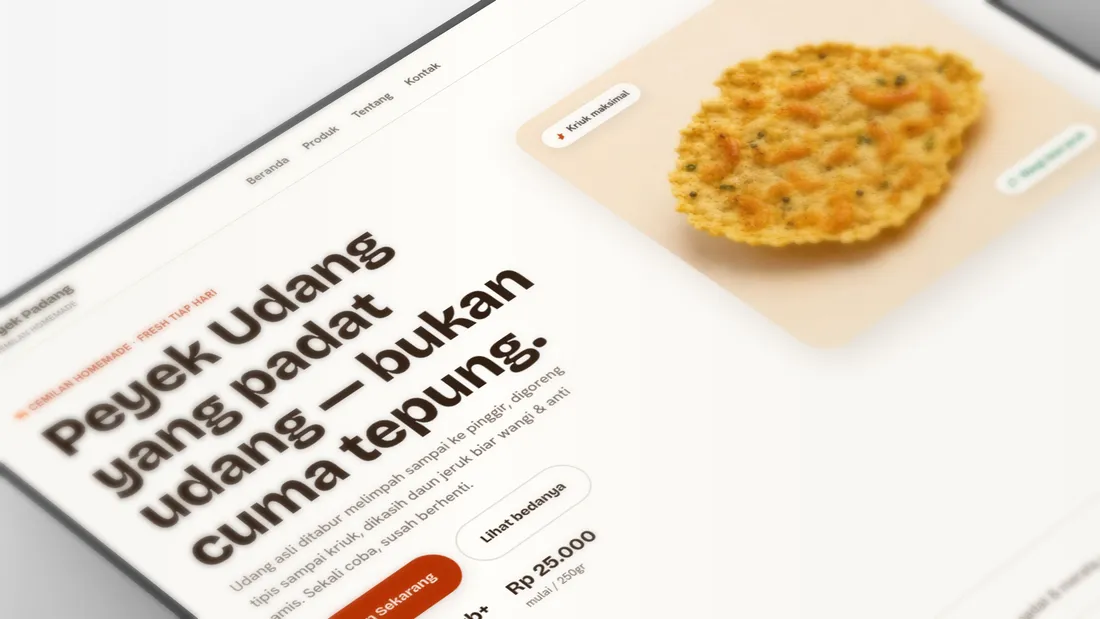
[DRAFT — translation to review] Case study: building an independent e-commerce website for a homemade shrimp-peyek business.
Overview
Peyek Padang is a simple e-commerce website for selling homemade shrimp peyek through its own domain: peyekudang.biz.id.
Previously the product leaned mostly on marketplaces. The problem is that on a marketplace, products like shrimp peyek tend to look the same: small photos, near-identical titles, competing prices, and buyers struggle to tell which product is genuinely high quality.
This website was built to give Peyek Padang its own storefront — a place where the product can look more convincing, carry a clear brand story, and offer a complete shopping flow from browsing the product, adding to cart, checkout, shipping check, all the way to online payment.
The whole project rests on one simple message:
“Padat Udang, Bukan Cuma Tepung.” (Packed with shrimp, not just flour.)
That message drives the design, the copywriting, the way the product is shown, and how the site explains its advantage to potential buyers.
Problem & Context
Peyek Padang is a home-based snack business selling shrimp peyek. The product has a strong advantage: the shrimp looks dense and evenly spread, not just a small piece in the middle or a token topping.
But an advantage like that is hard to see when the product appears as just one of many listings on a marketplace. Buyers usually look from a phone screen, compare many products at once, and decide within seconds.
The buyer’s real question is simple:
“Is this really shrimp peyek, or just flour peyek with a bit of shrimp on top?”
The website was built to answer that question more clearly — not only through words, but through visuals, product photos, page structure, and a tidier shopping experience.
Beyond branding, there were real operational constraints for a small business: the owner isn’t technical, so prices, product bundles, and page copy had to be editable without touching code. Services like the payment gateway and shipping API aren’t always ready on day one — verification takes time, yet the site still had to launch without waiting for every external service. Budget also had to be very lean, using technology that runs at the lowest possible operating cost.
So the challenge wasn’t just building a nice-looking website, but a store a small business can actually run: light, easy to manage, able to launch in stages, and cheap to operate.
Design Approach
The direction was mobile-first, since most buyers will likely open the site from a phone. The look is warm, clean, and still feels homemade — I didn’t want it to read like a stiff corporate brand, because the product’s strength is exactly that honest, homemade closeness to the buyer.
Instead of piling on claims, the site proves quality through visuals. Product photos are a key element, especially to show that the shrimp really is dense and evenly spread. The copy is kept simple and to the point — not just “tasty peyek,” but why this product is different: peyek where you actually taste the shrimp, not crunchy flour with a little topping.
Technical Approach
Technically the site was designed to keep working even when some external services aren’t active yet. That matters for a small-business project, where you often can’t wait for every account, verification, API, and integration to be finished before you start selling.
So the system is flexible. If the database isn’t populated, the site falls back to prepared default data. If the shipping API isn’t live, checkout still runs on a simple shipping estimate. If the payment gateway is still under verification, the payment flow can still be tested in demo mode.
This lets the site launch sooner, with extra features switched on one by one without taking the site down.
Admin Panel for the Business Owner
The site includes an admin area so the owner can manage the store without a developer every time. Through it, the owner can change prices, product bundles, and key copy — changes show up without a redeploy or touching code. The panel also helps manage orders: seeing incoming orders, updating payment status, adding tracking numbers, and marking orders complete. A small-business site can’t just be good on launch day; it has to be maintainable by its owner afterward.
SEO as a Long-Term Sales Channel
Besides the main product page, the site has supporting pages to help it surface on Google, targeting searches like “buy shrimp peyek online,” “how to keep peyek crispy,” “shrimp peyek for hampers,” and “shrimp peyek reseller.” FAQ, shipping-policy, and return-policy pages were added so the store looks more trustworthy. The goal isn’t only an online store, but a digital asset that helps the business get discovered organically over time.
Results
- An independent e-commerce website for Peyek Padang on its own domain: peyekudang.biz.id.
- A complete shopping flow: browse product → cart → checkout → shipping check → online payment.
- Around 18 pages, including product, SEO landing, FAQ, and policy pages — a fuller brand storefront, not just a simple sales page.
- The owner can manage prices and content through the admin panel, reducing dependence on a developer for small changes.
- A lean cost approach using services like Vercel and Supabase free tier — a good fit for a small business wanting its own site without heavy server costs.
- Most importantly, it doesn’t depend on “everything must be perfect before launch.” Fallbacks keep it running even if the payment gateway or shipping API isn’t fully active yet.
Tech Stack
- Next.js for the frontend and site structure
- Supabase for the database and admin authentication
- Vercel for deployment
- RajaOngkir for shipping-cost checks
- DOKU for the payment gateway
- A .biz.id domain as the main domain
Note
This case study focuses on the process of building a practical e-commerce site for a small business. Metrics like traffic, conversion, order counts, or sales lift aren’t included yet. Once that data is available from Vercel Analytics, Supabase, or the order dashboard, the results section can be strengthened with concrete numbers. From a digital-product standpoint, the main goal is already met: Peyek Padang has its own website to sell, build a brand, and reduce full dependency on marketplaces.