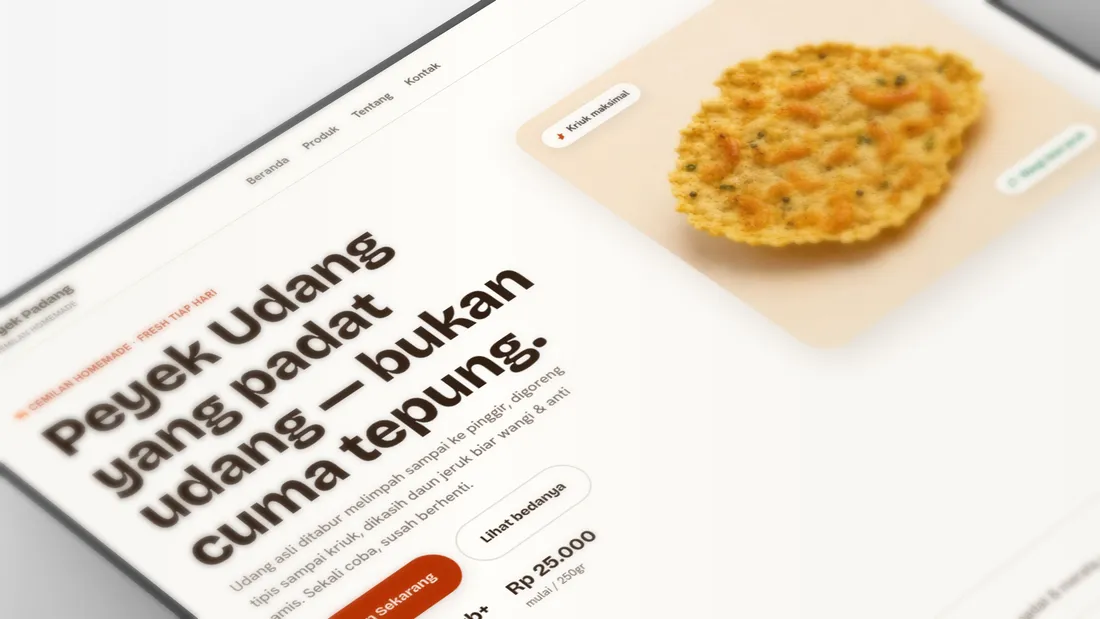
Peyek Padang is a home-based snack business that sells shrimp peyek through its own domain: peyekudang.biz.id.
Before this project, selling through marketplaces was the most obvious option. However, marketplaces also create one major problem: every product starts to look the same. When potential customers search for “shrimp peyek,” they see many listings with small photos, similar titles, and price-based competition.
The product itself has a clear advantage: the shrimp is visible, generous, and spread across the peyek, not just placed as a small topping in the middle.
This website was built to answer one simple question from potential buyers:
“Is this really shrimp peyek, or is it mostly flour with only a little shrimp on top?”
Starting Point: A Good Product That Was Hard to Notice in the Marketplace
The main challenge of this project was not just building a website.
The bigger challenge was helping a homemade product appear more trustworthy while competing with many similar products online.
On marketplaces, buying decisions happen very quickly. Customers look at the photo, price, rating, and then compare the product with many other options. In that situation, a real product advantage can easily be buried.
That is why the website was created as an independent storefront for Peyek Padang.
With its own website, the product can be presented more clearly. Photos can be shown larger. The brand story can be explained better. The shopping flow can feel more organized. Most importantly, the product does not have to sit side by side with dozens of similar marketplace listings.
Project Goal
The main goal was to build an e-commerce website that a small business could actually use.
Not just a beautiful landing page, but a functional online store with a complete shopping flow.
The website needed to display products, add items to cart, support checkout, calculate shipping costs, accept online payments, and help the business owner manage orders.
It also had to be easy for a non-technical owner to manage. Prices, product packages, and page content needed to be editable without opening code or waiting for a developer.
Because this was built for a small business, the operational cost also had to stay as low as possible.
Design Approach: Warm, Simple, and Appetizing
The website was designed with a mobile-first approach because most potential customers are likely to open it from their phones.
The visual direction was kept warm and simple, not too corporate or overly polished. The homemade feeling was intentionally preserved because it is part of the product’s strength.
The visual focus was placed on the product itself. Product photos were used to show that the shrimp is actually visible and spread across the peyek.
The copywriting was also kept direct and easy to understand. The main message of the website is:
“Packed with Shrimp, Not Just Flour.”
This message became the foundation of how the website presents the product. Instead of only claiming that the product is tasty, the website shows why it is different.
Technical Approach: A Website That Can Launch Step by Step
One of the most important decisions in this project was to make sure the website could still work even if some external services were not fully active yet.
In small business projects, this situation happens often. Payment gateway verification can take time. Shipping API access may not be ready immediately. Product data can also change during the early launch stage.
Because of that, the system was built with fallback flows.
If the database has not been filled yet, the website can still use default product data prepared in the code.
If the shipping API is not active yet, checkout can still continue using a simple shipping cost estimate.
If the payment gateway is still under verification, the payment flow can still be tested in demo mode.
With this approach, the website does not need to wait until everything is perfect before going online. The business can launch earlier, and additional features can be activated one by one.
Admin Panel for Non-Technical Owners
The website also includes an admin panel so the business owner can manage the store independently.
Through the admin panel, the owner can update prices, product packages, and main website content without touching code.
The admin panel was also prepared for order management, such as viewing incoming orders, updating payment status, adding tracking numbers, and marking orders as completed.
This matters because a small business website should not only look good on launch day. It should also be easy to maintain after the project is finished.
SEO as a Long-Term Asset
Besides the main product page, the website also includes supporting pages to help the business appear in Google search.
These pages were created to target long-tail search terms such as:
“buy shrimp peyek online” “how to keep peyek crispy” “shrimp peyek for hampers” “shrimp peyek reseller”
FAQ, shipping policy, and return policy pages were also added to make the website feel more complete and trustworthy.
The goal was not only to create an online store, but to build a digital asset that can help the business get discovered organically over time.
Results
The result of this project is an independent e-commerce website for Peyek Padang on its own domain: peyekudang.biz.id.
The website has a complete shopping flow, from viewing the product, adding it to cart, checking out, checking shipping costs, and continuing to online payment.
The website also includes around 18 pages, including product pages, SEO landing pages, FAQ, shipping policy, and return policy.
The business owner can manage prices and website content through the admin panel, reducing dependency on a developer for small updates.
From the cost perspective, the website was built using services such as Vercel and Supabase free tier to keep operational costs low.
Most importantly, the website can launch step by step. The system can still run even if the payment gateway, database, or shipping API is not fully active yet.
Tech Stack
This project was built using:
Next.js for the frontend and website structure. Supabase for database and admin authentication. Vercel for deployment. RajaOngkir for shipping cost calculation. DOKU for payment gateway. .biz.id domain as the main website domain.
Closing Note
This project shows that a small business website does not have to be complicated or expensive.
What matters most is whether the website solves real problems: making the product look more trustworthy, helping customers buy more easily, and giving the business owner control over their own store.
For Peyek Padang, this website became an early step toward building its own brand outside the marketplace.