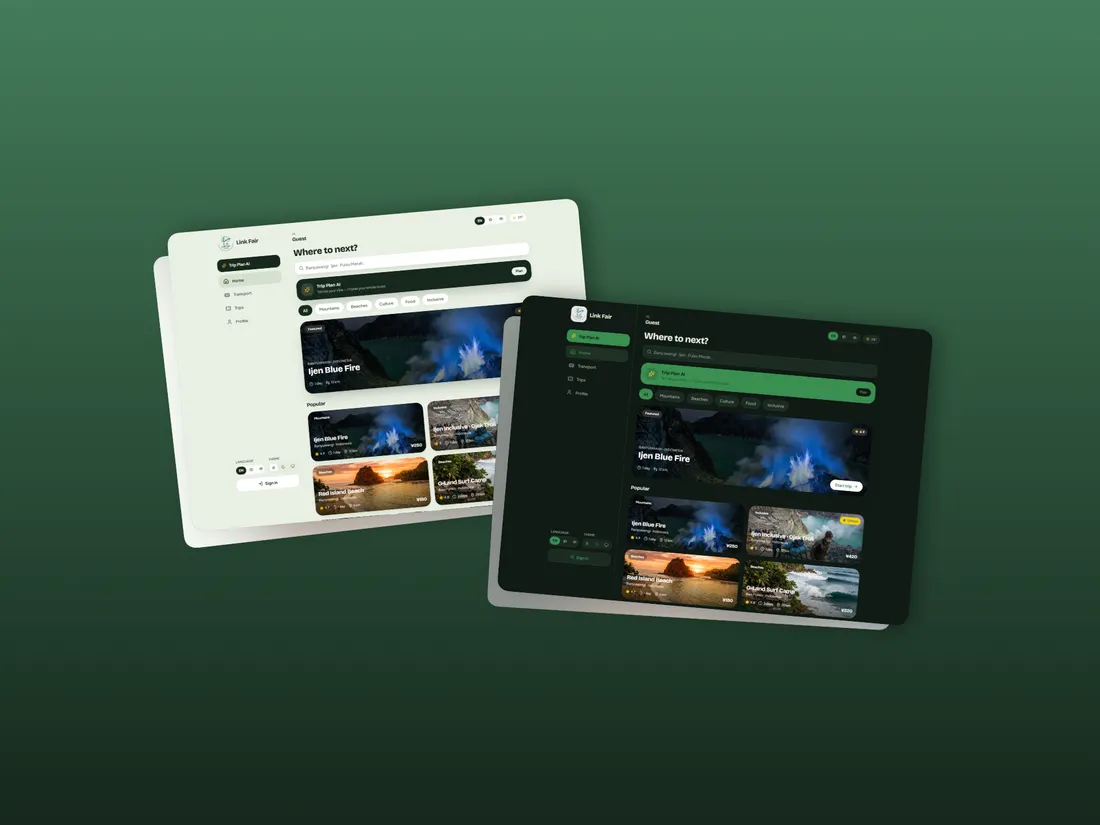
Link Fair: A Cross-Border Travel Booking Platform with Proactive AI Refunds
Travel refunds are still more painful than they should be.
Imagine booking an Ijen Crater tour through an online travel platform. Your itinerary is set, your transport is arranged, and everything looks ready. Then, one day before departure, the trail is officially closed because of high winds.
The closure is public information. The incident is real. The platform could have known before you did.
But in most cases, the burden still falls on the traveler. You have to file a complaint, upload proof, wait for manual verification, and then wait again for the refund to be processed.
That experience became the starting point for Link Fair.
Link Fair is a cross-border e-commerce platform for travel and transport services, designed to connect Chinese tourists with ASEAN destinations. For the pilot, we chose Banyuwangi, Indonesia, a destination with strong tourism potential but many local services that are still missing from international booking platforms.
We built this project for the 2026 China-ASEAN “AI + Cross-Border E-Commerce” Innovative Application Competition. Inside the product, the brand is called Link Fair, with the Chinese name 惠行 / Huixing.
The Problem We Wanted to Solve
Link Fair was built around three core problems.
- The first problem is that travel refunds are often slow, manual, and one-sided. Most major online travel agencies have force-majeure policies, but the actual process usually starts only after the user complains. For incidents such as trail closures, extreme weather, or operator cancellations, the platform should be able to detect the issue earlier and help the traveler proactively.
- The second problem is that many essential local transport services are still not bookable online. In Banyuwangi, services such as Lin shared minivans, ojeks, becaks, Ijen Jeeps, and other informal local transport options are highly relevant to the travel experience. Yet they are difficult to find on major platforms such as Ctrip or Klook, especially with CNY pricing, a Mandarin interface, and payment methods familiar to Chinese travelers.
- The third problem is that tourism is not always inclusive. Ijen Crater is a remarkable destination, but it is not easy to access for elderly travelers or people with disabilities. On the ground, however, a local solution already exists: Ojek Troli, a porter service that uses push carts to help visitors travel from Paltuding toward the crater area. Link Fair turns services like this into bookable tourism products with clearer schedules, pricing, and refund policies.
The Core Features
Link Fair has two main AI-powered features.
The first is AI TourGuide, a trip planner that helps users build itineraries based on their travel preferences. Users can choose from categories such as mountains, beaches, culture, food, religious sites, and more. The AI then generates a multi-day itinerary with a clear explanation for why each stop is recommended.
Each itinerary item is not just a suggestion. It is designed to connect directly to a bookable travel product, with prices shown in CNY and the experience adapted for cross-border travelers.
However, we knew from the beginning that AI trip planning alone would not be enough. Platforms like Trip.com and Fliggy already have mature versions of this feature. That is why AI TourGuide is not the main differentiator.
The real hero feature is FairCancel AI.
FairCancel AI is designed to make refunds proactive, transparent, and fast. The system receives incident data, such as trail closures, extreme weather, or operator cancellations. It then reads the incident report, compares it with the booking data and user report, checks whether the claim is consistent, and decides whether the traveler is eligible for a refund.
If the claim is valid, the system calculates the refund percentage based on the policy and provides a written explanation in the user’s language. For the demo, our target scenario is a 100% refund processed in around 30 seconds, without requiring the user to manually file a complaint.
We also added a Refund Simulator, so users can understand possible refund scenarios before purchasing. Instead of hiding cancellation rules inside long terms and conditions, Link Fair brings refund transparency into the booking experience itself.
Product Direction
Link Fair is not meant to be just another travel app. It is designed specifically for the China-ASEAN travel and commerce context.
Because the initial target users are Chinese tourists, the product supports a multilingual experience across Indonesian, English, and Mandarin. Prices can also be displayed in CNY, helping users understand travel costs without manually converting currencies.
Beyond popular destinations, Link Fair also gives space to local services that are usually invisible on major platforms. This matters because services such as village transport, local jeeps, porters, and Ojek Troli often shape the real travel experience on the ground.
In that sense, Link Fair is not only helping travelers book more easily. It also creates a digital bridge for local tourism operators to participate in the cross-border economy.
The Technical Side
Because the qualification stage had a short development timeline, we chose a web-first approach. The MVP was built with Next.js, React, Tailwind CSS, TypeScript, and deployed on Vercel. For authentication and persistence, we used Supabase.
One important part of the system is multilingual support. We used a central dictionary to keep the user experience consistent across Indonesian, English, and Mandarin. For refund decisions, the rules engine does not return a finished sentence directly. Instead, it returns a reasonKey, allowing the explanation to follow the active UI language.
The destination data is also not fully hardcoded. We built a pipeline to process scraped Google Maps data. From around 700 raw rows, we curated 88 relevant destinations, complete with coordinates, ratings, and categories.
For flight data, the system connects to the Duffel API on the server side. When available, it can show airline details, prices, cabin information, baggage, and duration. But if the token is missing or no offers are returned, the app still works by falling back to AI-based estimates instead of breaking the user experience.
A Flexible AI Architecture
One of the most important technical decisions was making the AI provider swappable through environment variables. When AI_PROVIDER=anthropic, the system uses the native Claude API. Otherwise, it can connect to any OpenAI-compatible endpoint.
We also prepared a separate FastAPI backend using DeepSeek and Google Search for deeper route research. Still, the app is designed to run end to end even without API keys. This was important for demo stability, especially when external integrations could fail.
For FairCancel AI, both the rules engine and the LLM share the same output contract. Every refund decision follows the same structure: refundPercent, faultParty, status, fraudRisk, and a reason.
The demo version uses deterministic rules that mimic the structure of an AI-generated decision. If we want to replace it with a full LLM-based implementation later, we only need to swap one function. The UI does not need to know which engine produced the decision, because the output shape stays the same.
This principle applies throughout the system: integrations may fail, but the application should not. If the AI times out, the system falls back to a baseline itinerary built from geographic proximity. If Duffel does not return flight offers, the system shows estimates. If the same AI response has already been generated for the same preferences, it is cached to avoid unnecessary API calls.
Honest Simulation
Some parts of the MVP, such as Alipay payment, weather-agency feeds, park-authority data, and document verification, are still simulated. However, we built them with realistic UI flows and clearly marked them as simulated during the pitch.
For us, this matters. The competition evaluates the scenario, feasibility, and innovation potential, not whether every production integration is already live at the qualification stage. It is better to be honest about what is simulated than to overclaim accuracy or integrations that do not exist yet.
What We Learned
The biggest lesson from building Link Fair was that competitor research can completely change the direction of a product.
At first, we wanted to position the AI trip planner as the main innovation. But after benchmarking Trip.com, Fliggy, Klook, and Mafengwo, it became clear that trip planning is already becoming standard in travel tech. If we kept pitching the planner as the core differentiator, the idea would sound too generic.
What felt more defensible was the combination of three things: proactive refunds, informal local transport, and inclusive tourism. These three ideas came from real pain points, not from technology looking for a problem.
The second lesson was the value of designing the system contract before finalizing the engine. Because we locked the FairCancel output structure early, we could run the demo on a rules engine while still keeping the path open for a full LLM implementation later. That made the product faster to build, more stable to demo, and easier to extend.
The online qualification round closed on June 30, and the offline final is scheduled for late July in Nanning. Whatever the final result, building a trilingual MVP with AI features that degrade gracefully was an engineering experience worth documenting.
Link Fair is not just an AI experiment for travel. It is a way to rethink how cross-border tourism platforms should work: more proactive, more transparent, more local, and more human.